Business Managed Cybersecurity: Coeur d’Alene, Post Falls, & Spokane

We Monitor
Intechtel continuously monitors your network and systems for signs of cyber threats.

We Analyze
Our security experts assess potential risks and determine the best course of action to protect your business.

We Respond
If a threat is detected, we act quickly—blocking attacks, securing systems, and notifying you as needed to minimize disruption.

We Monitor
Intechtel continuously monitors your network and systems for signs of cyber threats.
We Analyze
Our cybersecurity experts assess potential risks and determine the best course of action to protect your business.
We Respond
If a threat is detected, we act quickly—blocking attacks, securing systems, and notifying you as needed to minimize disruption.
Protect Your Business. Reduce Your Risk.
Essential Plan: Managed Cybersecurity
You’ve worked hard to build your business. Protecting it starts with a strong cybersecurity foundation.
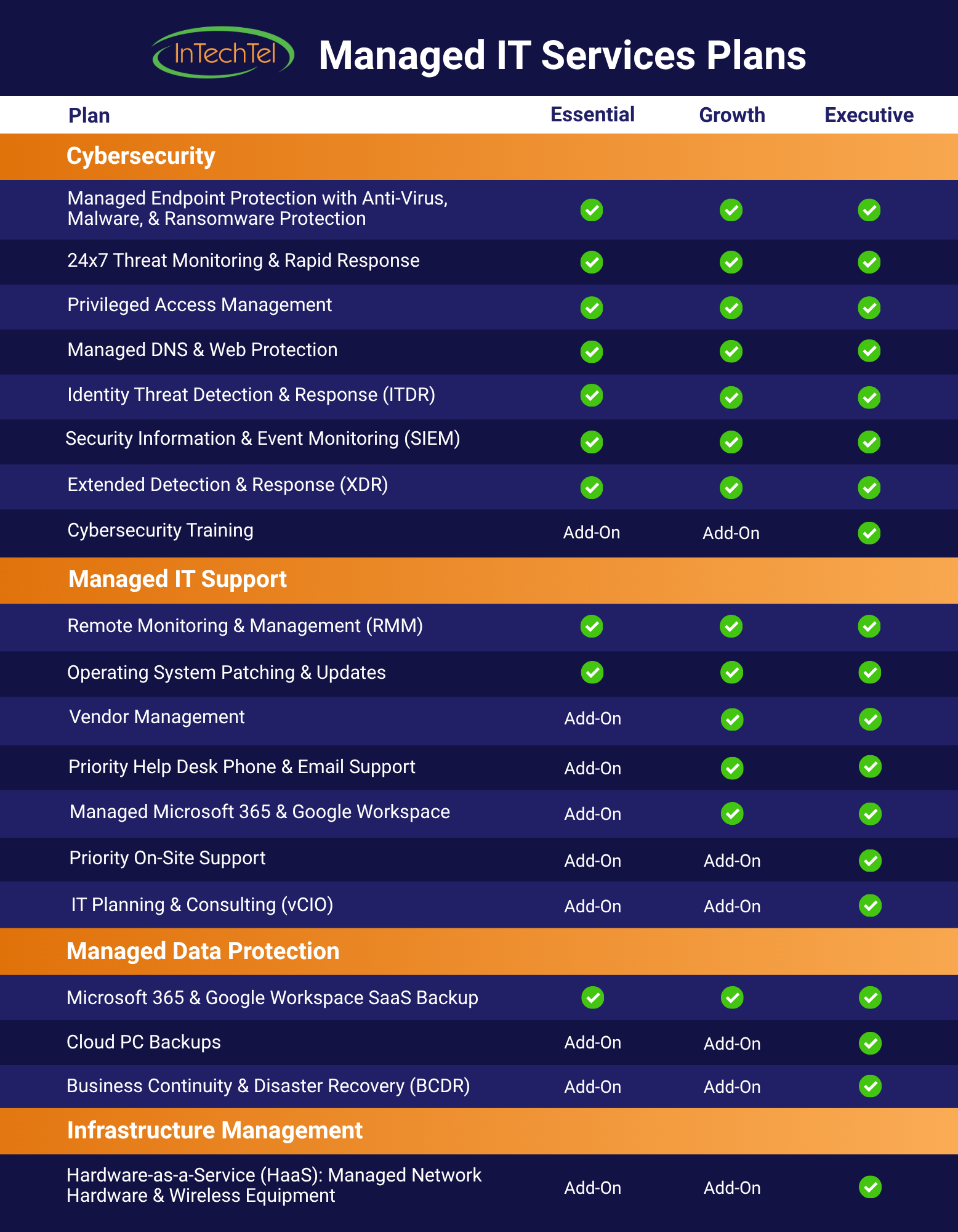
Antivirus alone is no longer enough. Today’s threats target users, devices, email, identities, and access to your systems. Our Essential Managed IT plan provides the core cybersecurity protection every business needs for a predictable flat monthly fee, with layered security, ongoing monitoring, and IT support available as needed.
Protect your business today with a Cybersecurity or Managed IT plan.
- Advanced Threat Prevention: Anti-Malware
- Endpoint Detection & Response (EDR): Threat Detection
- Managed Detection & Response (MDR): 24/7 Monitoring
- Email Security, Filtering and Backups
- Privileged Access Management (PAM): Manage Users
- Patch Management: Latest Updates
- Identity Threat Detection & Response (ITDR): Block Hackers
- Managed DNS Security: Monitoring and Lockouts
Managed Cybersecurity Plan Details
Advanced Threat Prevention:
With nearly a million new threats targeting computers and networks every day, it’s critical to have the most up-to-date protection. Antivirus software helps safeguard your devices from these cyber threats and attacks.
Intechtel uses an advanced antivirus strategy that utilizes predictive behavior recognition technology coupled with the almost limitless processing power of cloud computing. Outdated antivirus detection tends to be ineffective and easily overwhelmed by modern malware threats. Unlike conventional antivirus protection, our approach stops malware and zero-day threats the moment they occur.
Also, no more remembering to update antivirus software. Regularly scheduled updates are cloud-based and only take about 30 seconds, never impacting device performance.
Endpoint Detection & Response (EDR):
Going beyond the typical signature-based antivirus/anti-malware is endpoint detection and response (EDR). Unlike traditional antivirus, EDR combines real-time behavioral analysis with automated response and remediation tools. This provides a deeper layer of security while still working alongside your existing antivirus software.
While antivirus software may detect a virus and handle it, EDR goes further. It provides powerful forensic tools that show how the attack happened, which system processes were affected, and which user accounts were involved.
This is enormously helpful to us in determining the “what, why, and how” of a breech, and is a component of our managed cybersecurity plan.
Managed Detection & Response (MDR):
Get around-the-clock monitoring through our Managed Detection & Response (MDR) service, powered by your local, expert IT specialists acting as your virtual Security Operations Center (SOC).
A SOC is a dedicated team that provides continuous (24/7/365) monitoring, threat analysis, and rapid response against cyber attacks. Our team brings extensive experience from both the public and private sectors, ensuring your business receives the same expertise as larger organizations.
When a detected threat escalates beyond what traditional antivirus or EDR can handle, our MDR team takes immediate, decisive action to protect the affected system and the rest of your network. They also work to remove intruders and assist with remediation, helping prevent any further issues.
With Intechtel’s managed cybersecurity and IT services, SOC monitoring through MDR is included by default, giving your business professional, round-the-clock protection from local experts you can trust.
Email Security, Filtering, and Backups:
Email is the primary entry point for most cyber threats, with many attacks starting when a malicious email is opened or an infected attachment is downloaded. Email security filtering uses data analytics, behavioral analysis, and AI to block dangerous messages before they reach your inbox.
These services can also prevent Business Email Compromise (BEC) and impersonation attacks. They detect when an outsider tries to trick employees by spoofing a colleague’s name or using a similar-looking email address, aiming to get them to click a link, download a file, or take other actions.
This service helps to reduce the human error factor by making sure these messages never make it to a users inbox in the first place. Email backups also take copies of emails and other cloud stored data such as that in OneDrive, Sharepoint, and teams so that you have a backup of this data in the event of a data loss, accidental, or intentional deletion.
Privileged Access Management (PAM):
Privileged Access Management (PAM) ensures that employees only have access to the systems and data they need to do their jobs. By controlling who can access sensitive information, when they can access it, and under what conditions, PAM reduces the risk of internal errors or malicious activity.
It also provides detailed logs and audit trails to monitor usage and detect unusual behavior. This level of control is critical for safeguarding assets and maintaining compliance with industry regulations. With PAM, your business gains both security and visibility into how privileged accounts are used across your organization.
Patch Management
Patch Management keeps all your devices, software, and applications up to date with the latest security patches and updates. Regular patching helps close vulnerabilities before they can be exploited by cybercriminals, reducing the risk of ransomware, malware, and other attacks. Automated patch deployment ensures updates happen consistently without disrupting business operations.
In addition to security, patch management can improve system performance and stability. It also provides visibility into which systems are current and which may need attention, helping IT teams stay proactive.
Managed DNS Security:
Managed DNS Security adds a critical line of defense by controlling how devices on your network connect to the internet. Instead of waiting for threats to reach your systems, DNS Security blocks access to known malicious domains, phishing sites, and command-and-control servers at the source.
By filtering traffic before it ever leaves your network, it prevents attackers from gaining a foothold and reduces the chance of data exfiltration or malware downloads. Beyond blocking, it also gives visibility into which devices are making suspicious requests—valuable intelligence for spotting compromised accounts or systems.
As part of our managed cybersecurity package for small businesses, Managed DNS Security works seamlessly alongside tools like antivirus and EDR, or it can be deployed independently for targeted protection.
Identity Threat Detection and Response (ITDR):
Identity Threat Detection and Response (ITDR) protects user accounts and identity systems—like Microsoft email, Active Directory, and Entra/Azure AD—from takeover by cybercriminals. It monitors normal user behavior, detects suspicious logins, spots impossible travel attempts, and analyzes unusual activity to stop threats before they cause damage.
ITDR can automatically lock compromised accounts and alert Intechtel’s IT experts for quick remediation. This is especially important for high-level users, such as administrators, who are frequent targets for attackers seeking network access.
ITDR also prevents token theft, where attackers hijack legitimate sessions and bypass Multi-Factor Authentication (MFA)—even through something as simple as clicking a phishing link. With ITDR, your business gains proactive protection that secures critical accounts and keeps attackers out.
Add-On Security Services
Ongoing Employee Training:
Even with the most advanced cybersecurity firm services, it is imperative that employees understand risks and defenses. If employees aren’t careful, they may unknowingly permit threats or cyberattacks. That’s where Intechtel’s hands-on and digital training come in. Intechtel can ensure that each employee learns and demonstrates an understanding of cybersecurity.
This layer of protection is vital in any business with multiple employees. Regarding internal security, Intechel can create parameters and access barriers to lower risk from inside attacks.
Business Continuity Disaster Recovery (BCDR):
It should be said that no company can guarantee 100% protection against cyberattacks. Intechtel’s BCDR services are a set of processes that help a business continue operating after a cyberattack or major data loss.
A main function of this service is ensuring proper back up data is stored and available should a natural or cyber disaster take place.
This BCDR service is recommended to be used with other cybersecurity services.
Managed Firewall
Managed Firewall with IPS (Intrusion Prevention System):
Unlike the DNS security service Intechtel offers that is cloud-based, the firewall with IPS is installed on-location near the network server. This on-site firewall offers an additional layer of protection as it denies unauthorized access and malicious activities at the network level.
IPS works by preventing unwanted traffic to reach it’s intended victim. Suspicious data packets are immediately dropped before they cause extreme damage to the network.
Additionally, a firewall with IPS not only monitors network traffic but protects against intrusions that take place on the network itself. Managed firewalls with IPS are available as part of our managed security and networking offerings.
Additional Cybersecurity Services
Audit and Recovery Cybersecurity Services

Intechtel also provides critical support in the event of a cyberattack. We understand how devastating cybercrime can be, often leaving you unsure of the full extent of the damage. Our team conducts comprehensive audits to assess data loss and damage, then develops and implements a recovery plan to get your business operational as quickly as possible.
Monthly Managed IT Support Plans

Partner with a local Managed IT Service Provider (MSP) for expert support across all your technology needs. In addition to comprehensive cybersecurity, an MSP handles network management, cloud solutions, email systems, backups, and day-to-day IT support. With predictable costs and proactive monitoring, your business stays secure, efficient, and running smoothly.

Cyber Threats Articles

What is a phishing attack?
Learn how a phishing attack works and discover practical steps to protect your business from these deceptive emails and fake websites.

Malware, Spyware, and Ransomware explained.
Not all cyber threats are the same. Learn how each works—and how to protect your business—in our full article.

What is a token theft attack?
Some cyberattacks skip passwords, exploiting overlooked digital keys to slip in unnoticed. Learn more about how token attacks can hurt your business.
A Complete Cybersecurity Glossary
AV / EPP — Antivirus / Endpoint Protection Platform
What it is:
Core security software installed on every workstation and server. Think of it as the first guard at the gate.
Why it matters:
Threats evolve daily. Traditional antivirus relies on known signatures, which is only half the story. EPP adds behavioral analytics, machine learning, and real-time cloud intelligence.
How it protects:
Stops known malware, detects suspicious file behavior, blocks exploit attempts, and provides a foundational layer that every other security service builds on.
EDR — Endpoint Detection and Response
What it is:
Continuous monitoring of device activity that looks for patterns attackers use during real-world breaches.
Why it matters:
Cybercriminals don’t always drop malware. They hijack built-in tools, steal tokens, and move quietly. EDR sees the stuff AV misses.
How it protects:
Captures forensic-level detail, detects lateral movement, isolates compromised devices, and automatically responds to high-risk behaviors.
MDR — Managed Detection and Response
What it is:
A 24/7 human security team layered on top of automated detection tools.
Why it matters:
Automation is great, but humans recognize nuance. Attackers actively try to mimic normal activity. MDR is trained to spot the subtleties.
How it protects:
Security analysts investigate alerts in real time, validate threats, stop false positives from derailing the business, and take immediate action when something isn’t right.
XDR — Extended Detection and Response
What it is:
A unified security platform combining endpoint, identity, email, cloud, and network telemetry into one detection engine.
Why it matters:
Attacks rarely hit one system. They move across accounts, devices, and services. XDR connects the dots.
How it protects:
Correlates signals, builds a full picture of an attack, identifies multi-stage threats, and automatically stops them across multiple systems.
SOC — Security Operations Center
What it is:
A dedicated security command center staffed by cybersecurity analysts, threat hunters, and incident responders.
Why it matters:
Threats operate 24/7, not 8–5. Your defenses must do the same.
How it protects:
Monitors your environment around the clock, blocks live attacks, reviews suspicious events, and coordinates rapid response when something needs attention.
SIEM — Security Information and Event Management
What it is:
A platform that centralizes logs from servers, firewalls, applications, and identity systems — then analyzes them for anomalies.
Why it matters:
Every attack leaves fragments of evidence. SIEM is where those fragments come together.
How it protects:
Detects insider threats, privilege misuse, unusual access patterns, and signs of compromise that no single system would catch alone.
PAM / IAM — Privileged Access Management / Identity & Access Management
What it is:
Systems that manage who can log in, what they can access, and how their credentials are protected.
Why it matters:
Stolen accounts are the fastest-growing attack vector. Privileged accounts (admin, finance, HR) are the crown jewels.
How it protects:
Restricts high-level access, enforces strong authentication, rotates credentials, controls permissions, and logs every sensitive action.
Patch Management
What it is:
A structured, automated process to update operating systems, apps, and drivers.
Why it matters:
Unpatched software is security debt. Attackers actively scan the internet looking for known, unpatched vulnerabilities.
How it protects:
Closes security holes, reduces exposure windows, standardizes updates, and significantly lowers the risk of ransomware or remote exploitation.
IGA — Identity Governance and Administration
What it is:
The framework for controlling user access over time. Onboarding, changes, and offboarding.
Why it matters:
Accounts accumulate access unless controlled. Old accounts and over-privileged users create silent, long-term risk.
How it protects:
Enforces least privilege, cleans up old access, automates removals when employees leave, and ensures compliance with internal policies.
Zero Trust
What it is:
A security philosophy where no user or device is inherently trusted.
Why it matters:
Remote work, cloud apps, and mobile devices shattered the traditional “internal network = safe” model.
How it protects:
Requires continuous identity verification, checks device health, enforces conditional access, and blocks risky activity automatically.
Managed DNS
What it is:
Security filtering at the domain lookup layer, the phonebook of the internet.
Why it matters:
Most attacks begin with a bad link or a command-and-control server callout.
How it protects:
Blocks malicious sites, stops malware communication, filters phishing domains, and enforces safe browsing policies before a connection is ever made.
PSA — Professional Services Automation
What it is:
The operational backbone for service delivery, scheduling, incident tracking, and documentation.
Why it matters:
Security failures often come from inconsistent processes, not lack of technology.
How it protects:
Ensures incidents are logged, handled, escalated, and resolved with structured workflows and accountability.
RMM — Remote Monitoring and Management
What it is:
A centralized platform for monitoring device performance, deploying updates, and enforcing policies.
Why it matters:
Visibility and automation are essential for scale, consistency, and security.
How it protects:
Detects failing drives, CPU spikes, unauthorized software, service outages, and security changes. It then triggers automated remediation.
ITDR — Identity Threat Detection and Response
What it is:
Monitoring focused specifically on identity misuse, session hijacking, token theft, and abnormal login behavior.
Why it matters:
Modern attackers bypass passwords by stealing authentication cookies or tokens.
How it protects:
Identifies impossible travel, suspicious login sources, privilege abuse, session anomalies, and compromised accounts in real time.
BCDR — Business Continuity & Disaster Recovery
What it is:
A combination of backups, offsite replication, failover systems, and recovery procedures.
Why it matters:
Cyber incidents, hardware failures, and accidental deletions happen, often at the worst time.
How it protects:
Restores operations quickly, minimizes downtime, safeguards data integrity, and keeps the business running even during major outages.
DLP — Data Loss Prevention
What it is:
Policies and tools that prevent sensitive data from leaving the organization in unapproved ways.
Why it matters:
Data leakage damages trust, breaks compliance, and invites legal exposure.
How it protects:
Flags or blocks unauthorized file transfers, emails, uploads, prints, and copy/paste actions involving sensitive information.
IDS / IPS — Intrusion Detection & Prevention Systems
What it is:
Network-level detection and blocking of suspicious traffic.
Why it matters:
Threats can slip past firewalls by hiding in legitimate-looking network flows.
How it protects:
IDS alerts on malicious traffic. IPS blocks it automatically, preventing exploitation attempts and lateral movement.
SAT — Security Awareness Training
What it is:
Ongoing education for employees about cyber risks.
Why it matters:
People remain the easiest, most cost-effective attack vector for adversaries.
How it protects:
Reduces risky clicks, improves phishing recognition, and builds a culture where users report issues early instead of ignoring them.
NGFW — Next-Generation Firewall
What it is:
A firewall that analyzes traffic deeply, including encrypted traffic and applications.
Why it matters:
Most business traffic runs inside encrypted tunnels. Legacy firewalls can’t inspect what they can’t see.
How it protects:
Blocks advanced threats, enforces application policies, inspects encrypted sessions, and provides real-time threat intelligence filtering.
MFA — Multi-Factor Authentication
What it is:
Verification that requires at least two separate factors (password, device, biometrics).
Why it matters:
Password theft is widespread. MFA breaks the attacker’s playbook.
How it protects:
Stops unauthorized logins even if a password is compromised through phishing or brute force.
SASE — Secure Access Service Edge
What it is:
Cloud-delivered networking and security bundled into one model for remote and hybrid teams.
Why it matters:
Users, devices, and apps spread across home offices, travel, cloud platforms, and multiple networks.
How it protects:
Applies consistent access controls, content filtering, and threat prevention no matter where the user is.
DAG — Dynamic Access Groups / Conditional Access Logic
What it is:
Core security software installed on every workstation and server. Think of it as the first guard at the gate.
Why it matters:
Threats evolve daily. Traditional antivirus relies on known signatures, which is only half the story. EPP adds behavioral analytics, machine learning, and real-time cloud intelligence.
How it protects:
Stops known malware, detects suspicious file behavior, blocks exploit attempts, and provides a foundational layer that every other security service builds on.
Get a Free Cybersecurity Guide for Business
Download our free cybersecurity resource for business owners to strengthen security and train employees on essential cybersecurity practices.


Local Law Firm Saved From Email Cyber Attack
When a trusted legal partner became the source of a sophisticated phishing attack, Intechtel’s real-time detection and proactive defense saved the day. Find out what could have been if they didn’t have a managed IT plan in place.


Cybersecurity Support FAQ for Businesses
What does managed cybersecurity include?
How is managed cybersecurity different from antivirus software?
Does my business really need 24/7 monitoring?
Yes. Most cyberattacks happen after business hours because attackers expect slower response times. Around-the-clock monitoring helps block breaches before they spread and reduces downtime, data loss, and financial damage.
How does Intechtel protect against phishing attacks?
What happens if my business experiences a cyber incident?
Intechtel can assess the damage, identify what was affected, contain the threat, and start recovery steps to restore your systems. This includes data recovery, system cleanup, and strengthening your defenses to prevent repeat attacks.
Better Security Starts with a Conversation
Tell us a little about your business, team, and security needs so we can recommend the right protection and provide a quote.